Californians join forces to fight MK-Ultra
Source : http://wlym.com/archive/oakland/docs/19810606-WOD.pdf
In 1974, California became the first state to enact marijuana decriminalization following six years of fallout from the 1967 “Summer of Love” dopefest. On Jan. 24, 1981, the National Anti-Drug Coalition (NADC) held its first California statewide meeting in Los Angeles, where 200 citizens gathered to launch a rollback of the drug counterculture.
“Operation Rollback” was announced by keynote speaker Allen Salisbury, acting chairman of the NADC. The campaign will reduce marijuana trafficking and consumption in the United States by at least 50 percent, promised Salisbury. He then outlined specific initiatives to be taken by antidrug activists to kick off the drive.
Salisbury called for restoration of full funding to the federal Drug Enforcement Administration—especially the crucial Paris office which has been crippled by funding cuts by the Carter administration. He also announced that the NADC’s “Cannabis Control Act of 1981” calling for more stringent penalties for marijuana violations, would be lobbied for in all fifty states. “But in particular, we are committed to enacting ‘recrim’ in the 11 states—including California—that have decriminalized pot,” pledged Salisbury.
Three expert panels on key aspects of the drug problem followed Salisbury’s keynote and showed how a political movement is coming into being in California determined to carry out “Operation Rollback.”
Because California is the home state of President Reagan; as well as the capital of the entertainment industry that has glamorized the dope culture, an antidrug machine here will have national significance.
The first panel on legal action was led by State Senator Ed Davis and included Steve Helsley and Doug Silva of the Attorney General’s Bureau of Narcotics Enforcement. The next panel focused on drug treatment and prevention, and featured Dr. John Mays, chancellor of Technical Health Career School and a board member of PUSH, and Dr. Forest Tennant.
Both work with drug abusers and are experts on the medical effects of drugs. A final panel on community action highlighted two leaders of groups organized by parents to combat the drug culture and its effects on their children: Bill Brownell of WeTip (We Turn, in Pushers) and Jerry Pruitt, director of Parents for Anti-drug Coalitions around the world are on the offensive against the plague of the rock subculture. Bonnie Mesaros, Muriel Mirak and Nora Hamerman report on how campaigns in Los Angeles, Mexico, and Europe are educating and organizing citizens against the sinister tandem of rock and dope. However, more than a mere denunciation of rock, the mobilization is aimed at redefining a positive conception of human culture.
Action Against Drug Abuse in the town of Visalia. Marianna Wertz, chairman of the California Anti-drug Coalition and the coordinator of the Los Angeles event, also addressed this panel.
Many citizens groups were represented in the audience as well, including the Los Angeles Police Department, the National Farm Organization, the Arcadia Parents Alert, and the Gardena Coalition Against Paraphernalia. The president of a local Kiwanis Club, the Los Angeles Fire Commissioner, the deputy to a Los Angeles County Supervisor, several ministers, the mayor of Lawndale, and many young people, including an entire class from Pierce Junior College, were also there.
It was particularly fitting that so many leading California citizens should assemble to combat the drug plague since it was here that the ugly rock-drug counterculture was spawned 25 years ago.
MK-UltraIn 1955, when most Americans were first moving to the suburbs and dreaming of a better future for their children, the CIA and the Rand Corporation were readying the final phase of a secret operation known as MK-Ultra. The project, authorized by then CIA director Allen Dulles, studied the application of LSD, psilocybin, peyote, and other hallucinogens in brainwashing techniques.
In its earlier phases, hallucinogens were administered to volunteers in universities, hospitals, and mental institutions. A CIA document released in 1963, however, reveals that “the final phase of testing MK-Ultra materials involves their application to unwitting subjects in normal life settings,” and began in 1955 on the West Coast.
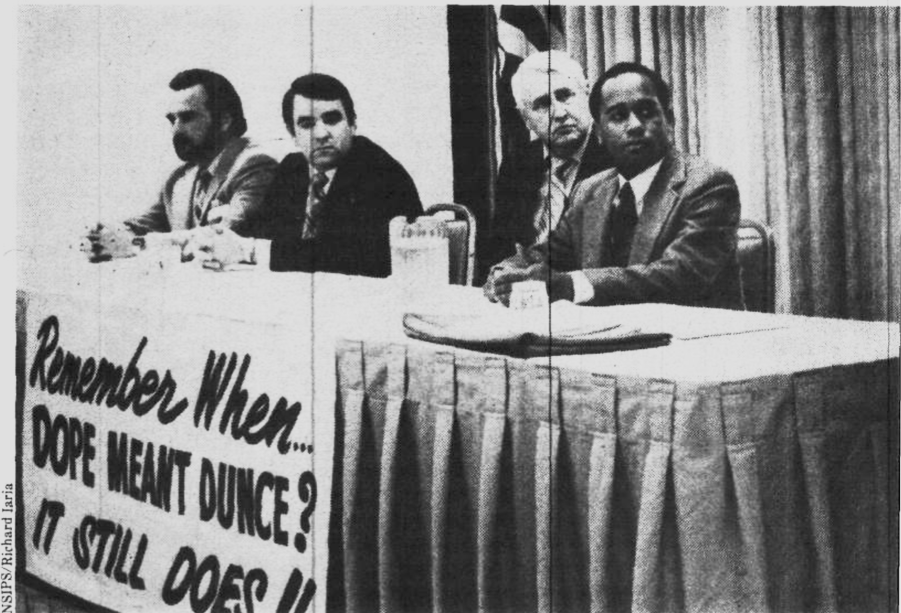
At the podium in Los Angeles: Doug Silva and Steve Helsley of the state Attorney General’s office, Sen. Ed Davis, and NADC chairman Allen Salisbury.
MK-Ultra, like the rock music that carried its message, was originally a British intelligence operation. Two of the British agents heading up MK-Ultra as research directors from 1952 on were Aldous Huxley, author of Brave New World, and Albert Hofmann, who first synthesized LSD in the 1930s at the Sandoz drug firm.
Palo AltoThe leading American researcher working with Huxley and Hofmann was Gregory Bateson, husband of the late Dame Margaret Mead. Bateson ran a Palo Alto Veterans Hospital where he aided Nazi-like experiments administering LSD to patients. Until his death in 1980, Bateson was a special adviser to California Governor Jerry Brown.
Timothy Leary, who recently attempted a comeback on an Orange County radio station until irate listeners had him fired, was by 1954 conducting LSD experiments at Harvard University. In 1967, Leary, along with Bateson recruit Ken Kesey, Alan Watts, a 1960s popularizer of death-oriented Eastern cults, and homosexual poet Allen Ginzberg organized the so-called Summer of Love. This nationwide orgy was the launching pad for an infusion of drugs into every part of the U.S.
A. and left thousands of young people ravaged by their first experiences with addictive and hallucinogenic drugs.
The MK-Ultra wizards then set up “free clinics” to deal with the mental and physical wreckage that resulted. The Haight-Ashbury Free Medical Clinic and Dr. Joel Fort’s Project One mental health clinic in San Francisco were created to serve as centers for the pro-drug movement and to popularize the widespread use of “recreational” drugs, such as LSD.
Senator Davis, former chief of the L.A. Police Department, kicked off the first panel of the NADC conference by talking about the generation of young people who missed being part of the Summer of Love. “Some of the best antidrug people in our American society, with the greatest degree of common sense,” he said, “are the young people under 25 who saw the excesses of their older brothers and sisters, who maybe, in many cases, even saw the excesses of their parents and got turned off, and believe that any kind of high you get from a chemical substance is stupid.
And I think our salvation in the future is going to arise out of that.”
Davis then spoke about his hope for a strong antidrug policy from the new Reagan administration. “One of our great hopes, an adult, is the fellow we have sitting back in the Oval Office.. .. This fellow, through whom all bills must go, vetoed all those [prodrug] bills in California—and he’s too old to change.”
Davis then took aim at the rock culture which has popularized the use of drugs by young people. “We had developed a whole sort of antiestablishment culture; we had music that became a carrier of that culture and if anyone tells you that music is not a culture carrier, then they don’t know anything about music. If you look at Handel and all his great works, which essentially were religious—the Messiah, and oratorios—he was a religious man. He was pushing a belief in God in his work, and it was very, very effective,” declared Davis.
Doug Silva, a special agent in the California Bureau of Narcotics, next gave a slide presentation on “Operation Sinsemilla”—an aggressive program to wipe out the huge marijuana-growing business in the state. When someone in the audience expressed skepticism about whether it was possible to make any headway against the billion-dollar pot crop, Silva surprised him by reporting that the sinsemilla crop, a high-potency variety of pot grown in California, had been reduced by 55 percent last year through sophisticated surveillance and law enforcement techniques.
State of the stateThe director of the California Narcotics Bureau, Steve Helsley, gave a “state of the state” report on narcotics enforcement. The “good news” he said, is the many groups like the one gathered in L.A. that day “who are giving law enforcement the support they need” to do the job.
Helsley pointed out several areas in which law enforcement could be aided through changes in existing statutes. One of these, he said, is the “posse comitatus” law dating from the Civil War period, which precludes federal troops from aiding local law enforcement officials. This means that military airplanes, satellites, U-2s, and other surveillance vehicles which spot suspicious activity like boats involved in drug smuggling are unable to report these findings to local police agencies.
Helsley also called for a law allowing the seizure and forfeiture of drug-related valuables, including cash. “We’ve got to be able to take away ill-gotten gains,” he declared. Helsley got an appreciative laugh from the audience when he said that the kids who were using dope in the 1960s were now moving into middle age, had their own families and responsibilities, and that this was “leading to an alternate ‘karma.’” This was best expressed, he said, by the fact that the drug lobby had been defeated time after time in the past five years in trying to pass a voter initiative to legalize “homegrown” marijuana.
PreventionDr. Forest Tennant, who led a panel on drug treatment and prevention, is the president of the largest drug treatment center in California and a researcher at UCLA. Dr.
Tennant challenged anyone who would defend the use of drugs to “come to one of our clinics and see if you still want legalization or want to have drugs used. I can assure you that you won’t,” he asserted. The physician expressed his gratitude for the work being done by antidrug groups like those represented at the event.
“There is no way to enforce the laws without community involvement,” stated Bill Brownell, founder and director of the nine-year-old organization WeTip. Mr. Brownell, who participated in the final panel on community action, is a former policeman who worked for the Los Angeles Sheriff’s Department. He startled many people at the meeting by informing them that 98 percent of all law enforcement is initiated by private citizens—this is the principle around which WeTip is organized.
Brownell pointed to impressive statistics to show the effectiveness of citizen involvement. In 1980, anonymous tips to his group resulted in the arrest of 2,600 major criminals, 1,300 convictions, and $40 million in drugs seized. In one case, one call led to the seizure of $7.5 million worth of LSD.
Last year, said Brownell, he was able to field 280,000 volunteer man-hours. With this kind of commitment, “we will be able to, as Dr. Tennant said, ‘overcome,’ “ concluded Brownell.
Jerry Pruitt, president of Parents for Action Against Drug Abuse in Visalia, described the process by which he and other parents who became alarmed when they found their children using drugs, formed an organization that now has the respect and cooperation of police and city officials. Mr. Pruitt’s story was told in the January issue of War on Drugs. Since then, he reported, “I’ve received telephone calls and letters coming in from as far away as Michigan, Pennsylvania, Texas, Georgia—from parents wanting to know what in the world can we do to protect our kids.”
Creating Beethovens“Our ultimate job is not just to stop drugs—it’s to create a renaissance in the culture,” stated Marianna Wertz of the NADC, the final panelist of the day. Mrs. Wertz described her own battle against Hodgkin’s disease, a form of cancer, and expressed a sense of gratitude that we have a nation which is committed to science and advanced medical technology. We need a renaissance “that can cure cancer, one that can begin to colonize space and most of all, one that will develop Beethovens,” she said.
“The thing that distinguishes the NADC … is that we are willing to engage in controversy, name names, we’re willing to go in and get our fingers dirty,” declared Mrs. Wertz.
Like Ed Davis, Mrs. Wertz lashed out at the rock counterculture. “I want to relate to you the most frightening thing that’s happened to me since I began speaking for the NADC,” she said. “It was going into a high school classroom and telling the students that John Lennon was the biggest drug pusher this country has ever seen.
… I got an explosion, much bigger than the explosion I got when I said marijuana causes brain damage. It’s through rock music that the drug culture is spread.
“We tell them that rock music started the drug culture,” she continued. “We tell them about groups like KISS. How many of you know what K-I-S-S stands for?” she asked.
“Knights in Service of Satan.
This is what we’re up against,” she said.
“But we’re tough, we’re going to survive … and we’re going to win this battle.”